
AP Score Calculator 2026: How Many Points You Need for a 5 in Every Subject
By Arpit Jain
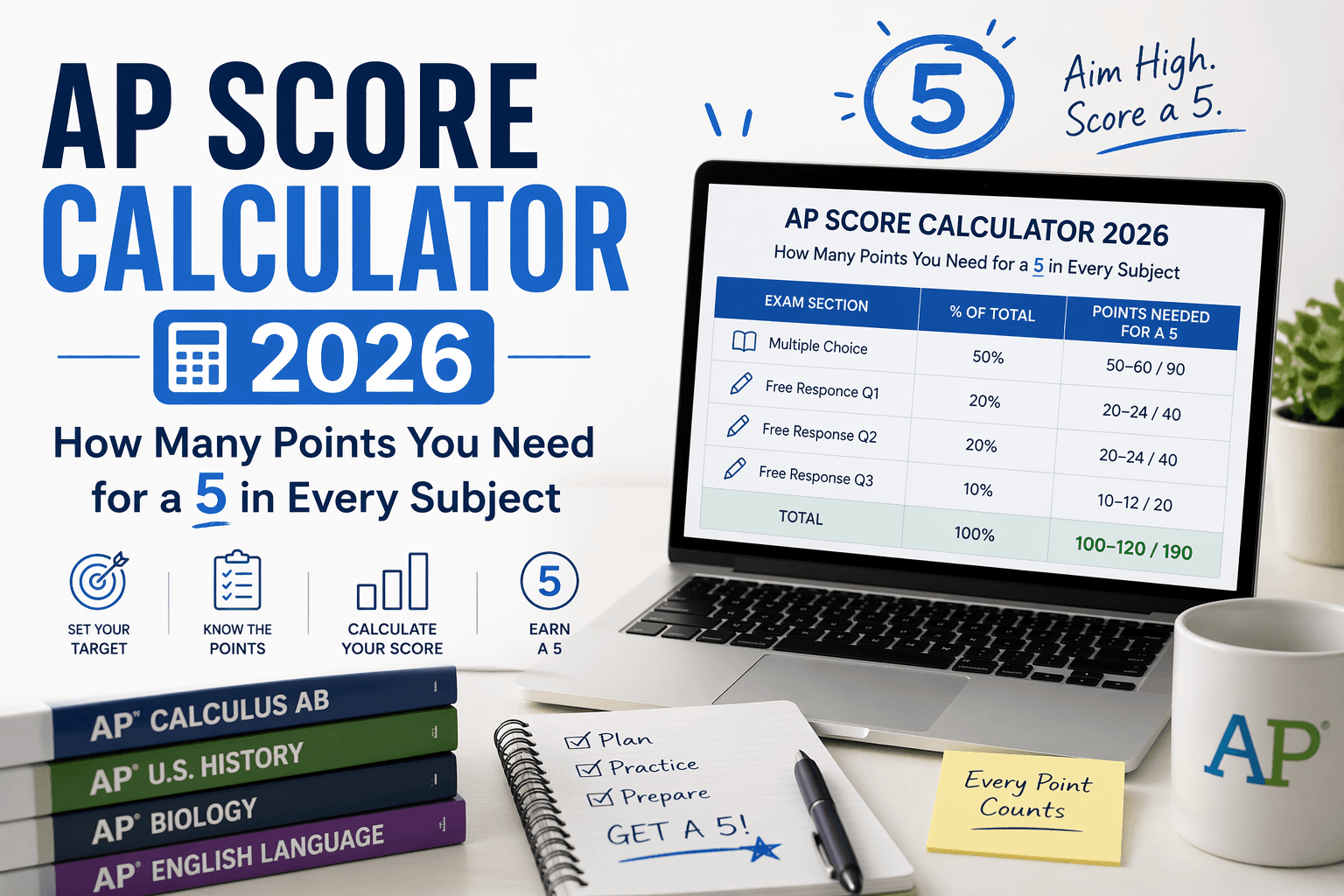
If you've been Googling "AP score calculator" at 1 a.m., you already know the question. How many points do I actually need to hit a 5? The short answer is fewer than you think. On most AP exams, you can miss roughly a third of the points and still walk away with a 5. That's the beauty (and the confusion) of the AP curve.
This guide pulls together raw score targets for every major AP subject, explains exactly how College Board turns your exam into a 1-to-5 score, and gives you a quick way to estimate where you're landing before score release day in July.
How AP Scores Are Actually Calculated
Every AP exam has two or three sections. For most subjects it's multiple choice plus free response. Your multiple choice section is scored by computer. Your free response section is graded by trained AP teachers and college professors during the AP Reading in June.
Those two section scores get combined into a weighted composite score, usually out of somewhere between 100 and 150 points depending on the subject. College Board then draws four "cut points" on that composite scale. Land above the top cut point and you get a 5. Land above the next one and you get a 4. And so on.
Here's the part most students miss. Those cut points are not fixed. They move every year based on how the exam performed, how students performed, and a statistical process called equating. That's why a 70% raw score might earn you a 5 one year and a 4 the next. The scale adjusts so that a 5 means the same thing every year, even if the test was harder or easier.
The Short Version: Raw Score Targets for a 5
Based on the last several years of released score distributions and the curves from popular AP calculators like Albert, here's a rough rule of thumb. These are estimates, not guarantees. The 2026 curves will shift a little. But if you're hitting these raw percentages consistently on practice exams, you're in real 5 territory.
STEM exams (where a 5 usually needs about 70 to 75% raw)
- AP Calculus AB: around 65 to 70% raw
- AP Calculus BC: around 65 to 70% raw (and you get a separate AB subscore too)
- AP Physics 1: historically one of the toughest curves, often 70%+
- AP Physics 2: similar to Physics 1, around 70%+
- AP Physics C Mechanics: around 70% raw
- AP Physics C E&M: around 70% raw
- AP Chemistry: around 70% raw
- AP Biology: around 65 to 70% raw
- AP Statistics: around 65 to 70% raw
- AP Computer Science A: around 65% raw
- AP Computer Science Principles: around 65% raw (plus your performance task)
- AP Environmental Science: around 70% raw
Humanities and social sciences (where a 5 usually needs about 65 to 70% raw)
- AP English Language: around 70%+ raw (the essay bar is high)
- AP English Literature: around 70%+ raw
- AP US History (APUSH): around 70% raw
- AP World History Modern: around 70% raw
- AP European History: around 70% raw
- AP Human Geography: around 65 to 70% raw
- AP US Government and Politics: around 70% raw
- AP Comparative Government: around 70% raw
- AP Macroeconomics: around 70% raw
- AP Microeconomics: around 70% raw
- AP Psychology: around 70% raw
- AP Seminar: based on performance tasks plus a written exam, target roughly 70%+
World languages and cultures (curves vary a lot by test format)
- AP Spanish Language: around 70%+ raw (speaking and writing are heavily weighted)
- AP Spanish Literature: around 65 to 70% raw
- AP French Language: around 70%+ raw
- AP German Language: around 70% raw
- AP Italian Language: around 70% raw
- AP Chinese Language: around 70%+ raw
- AP Japanese Language: around 70% raw
- AP Latin: around 65 to 70% raw
Arts and other special format exams
- AP Art History: around 65 to 70% raw
- AP Music Theory: around 65% raw (the sight-singing section catches a lot of students off guard)
- AP Art and Design (Drawing, 2-D, 3-D): scored on a submitted portfolio, so the "raw score" concept doesn't apply the same way
- AP Research: based on an academic paper and presentation
- AP Capstone (Seminar + Research): combined portfolio-based scoring
How to Estimate Your AP Score in 60 Seconds
You don't need a fancy calculator to get a rough read on your score. Here's the napkin math.
Quick AP Score Estimator
Enter your practice percentages and pick the exam type. You'll get a rough composite and a predicted score band.
Estimates only. Real AP curves shift year to year. Aim for 75%+ on practice exams to comfortably hit a 5.
First, figure out your multiple choice percentage. If there are 45 MCQs and you got 32 right, that's about 71%.
Second, estimate your free response score honestly. If the rubric is out of 9 points and you think you'd score a 6, that's about 67%. Be ruthless here. Students tend to over-estimate FRQ scores by 10 to 20%.
Third, average the two, but weight them how the exam weights them. On most AP exams, MCQ and FRQ each count for 50% of your composite. On AP Lang, AP Lit, and APUSH, the two sections are weighted roughly 45% MCQ and 55% FRQ. On most STEM exams it's closer to a true 50-50 split.
Finally, compare the weighted average to the targets above. If you're landing at 75%+ overall, you're comfortably in 5 territory even if the curve tightens a bit. At 65 to 70%, you're likely on the 4-to-5 bubble. Below 55%, a 3 is the realistic target.
Three Things Every AP Score Calculator Gets Wrong
Online calculators are useful for motivation, but they're not oracles. A few things worth knowing before you get hyped (or panicked) by a number.
They use old curves. Most calculators are built on the last published score distribution, which might be from 2022 or 2023. The 2026 test could be harder or easier, and the cutoffs will move.
They can't grade your FRQs. You're grading yourself, and you're probably being generous. If you want a more honest read, have a classmate or teacher score your practice FRQs using the official rubric.
They don't know about the section weightings that changed. College Board has quietly adjusted weightings on a few subjects in recent years (AP Bio, AP Precalc, AP CSP). If a calculator is more than a year old, double check the section percentages before trusting the output.
FAQ
Is a 5 really equal to a 70% score?
Sort of. On most AP subjects, the composite raw percentage for a 5 has historically hovered around 65 to 75%. It's subject-dependent and year-dependent, so treat 70% as a reasonable working target across the board.
Do colleges see your raw score?
No. They only see the 1-to-5 final score, and some colleges get access to your section-level performance via Score Reports. Your raw MCQ and FRQ numbers are not shared outside of College Board.
What if I bomb the MCQ section?
A bad MCQ is not a death sentence. If you crush the FRQs, especially on humanities exams where FRQs carry 55% of the composite, you can still hit a 4 or even a 5. The reverse is also true: a strong MCQ can rescue rough essays.
When are 2026 AP scores released?
College Board typically releases AP scores in early-to-mid July. You'll get an email when they're available, and you can log into My AP to view them.
The Bottom Line
If you take one thing from this post, take this: aim for a consistent 75% on every full-length practice exam. That's the floor that protects you from a tough curve, weak-grading FRQs, and the usual exam-day jitters. Hit 75% in practice and you'll almost certainly walk away with a 5 when scores drop in July.
And if you're not there yet? Two weeks of targeted work on your weakest section is worth more than another month of general review. Find the section killing your average, fix it, and the rest takes care of itself.