professor-curious-logo

Trade Routes: Silk Roads & Indian Ocean

Curated by Smr

Imagine a world where spices, silk, and precious metals traveled thousands of miles, connecting empires and cultures. The Silk Roads and Indian Ocean trade routes were the superhighways of the ancient world, facilitating not just the exchange of goods, but also ideas, religions, and technologies. This blog will take you on a journey through these historic trade networks, exploring how they grew, the innovations they spurred, and the lasting impact they had on civilizations.

Frequently Asked Questions

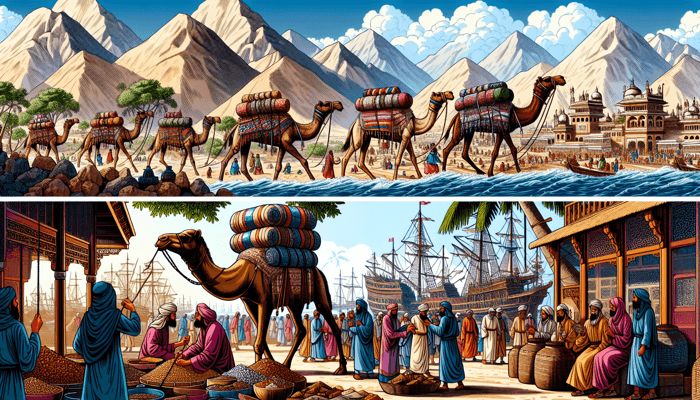
The Silk Roads were a network of overland trade routes linking China to the Mediterranean across Central Asia, while the Indian Ocean trade routes connected East Africa, Arabia, South Asia, Southeast Asia, and China by sea. Both carried silk, spices, precious metals, ideas, religions, and technologies from roughly 200 BCE through the early modern era.

Trade grew because of strong empires (Han, Roman, Byzantine, Islamic Caliphates, Tang, Mongol) that provided security and infrastructure, technological advances like the compass and dhow, rising urban demand for luxury goods, and the spread of commercial institutions like credit, contracts, and merchant diasporas that made long-distance exchange reliable.

Trade grew because of strong empires (Han, Roman, Byzantine, Islamic Caliphates, Tang, Mongol) that provided security and infrastructure, technological advances like the compass and dhow, rising urban demand for luxury goods, and the spread of commercial institutions like credit, contracts, and merchant diasporas that made long-distance exchange reliable.

Key maritime technologies included the Chinese magnetic compass, the astrolabe, lateen sails, the dhow in the Arabian Sea, and the Chinese junk. Overland innovations included caravanserais, improved saddles, and the camel caravan. These tools extended range, reduced risk, and allowed navigation far from shore using the Indian Ocean's monsoon winds.

Key maritime technologies included the Chinese magnetic compass, the astrolabe, lateen sails, the dhow in the Arabian Sea, and the Chinese junk. Overland innovations included caravanserais, improved saddles, and the camel caravan. These tools extended range, reduced risk, and allowed navigation far from shore using the Indian Ocean's monsoon winds.

Buddhism spread from India along the Silk Roads as monks, pilgrims, and merchants carried texts and teachings into Central Asia, China, Korea, and Japan. Monasteries along the routes served as safe stops and translation centres, and rulers like those of the Tang dynasty patronised Buddhist institutions, embedding the religion into East Asian culture.

Buddhism spread from India along the Silk Roads as monks, pilgrims, and merchants carried texts and teachings into Central Asia, China, Korea, and Japan. Monasteries along the routes served as safe stops and translation centres, and rulers like those of the Tang dynasty patronised Buddhist institutions, embedding the religion into East Asian culture.

Muslim merchants and Sufi missionaries carried Islam from Arabia along Indian Ocean routes to East Africa, South India, and Southeast Asia from the 7th century onwards. Port cities like Kilwa, Calicut, and Malacca became cosmopolitan hubs where conversion followed commercial integration, producing Swahili culture and Muslim-majority regions like Indonesia and Malaysia.

Muslim merchants and Sufi missionaries carried Islam from Arabia along Indian Ocean routes to East Africa, South India, and Southeast Asia from the 7th century onwards. Port cities like Kilwa, Calicut, and Malacca became cosmopolitan hubs where conversion followed commercial integration, producing Swahili culture and Muslim-majority regions like Indonesia and Malaysia.

The Mongol Empire created the Pax Mongolica (c. 1250-1350), a period of stability across a single political zone from Korea to Eastern Europe. Safe roads, standardised post stations (yam), and tolerant trade policies allowed goods, ideas, and travellers like Marco Polo to move with unprecedented ease — while also transmitting the Black Death.

The Mongol Empire created the Pax Mongolica (c. 1250-1350), a period of stability across a single political zone from Korea to Eastern Europe. Safe roads, standardised post stations (yam), and tolerant trade policies allowed goods, ideas, and travellers like Marco Polo to move with unprecedented ease — while also transmitting the Black Death.

Starting with Vasco da Gama's 1498 voyage around Africa, Portugal bypassed Islamic middlemen and forced its way into Indian Ocean ports. The Portuguese, and later Dutch and English trading companies, used armed ships to monopolise spices, tax trade, and control chokepoints — gradually shifting Indian Ocean commerce from a multi-ethnic network to a European-dominated one.

Starting with Vasco da Gama's 1498 voyage around Africa, Portugal bypassed Islamic middlemen and forced its way into Indian Ocean ports. The Portuguese, and later Dutch and English trading companies, used armed ships to monopolise spices, tax trade, and control chokepoints — gradually shifting Indian Ocean commerce from a multi-ethnic network to a European-dominated one.

The routes spread religions (Buddhism, Islam, Christianity), technologies (paper, printing, gunpowder, the compass), crops (sugarcane, cotton, citrus), and languages. They produced syncretic cultures in trading cities, diffused scientific knowledge from the Islamic world to Europe, and tied Afro-Eurasia into a shared economic system long before the modern global economy.

The routes spread religions (Buddhism, Islam, Christianity), technologies (paper, printing, gunpowder, the compass), crops (sugarcane, cotton, citrus), and languages. They produced syncretic cultures in trading cities, diffused scientific knowledge from the Islamic world to Europe, and tied Afro-Eurasia into a shared economic system long before the modern global economy.