professor-curious-logo

The Ultimate APUSH Unit 8 Timeline Cheat Sheet

Curated by Elise

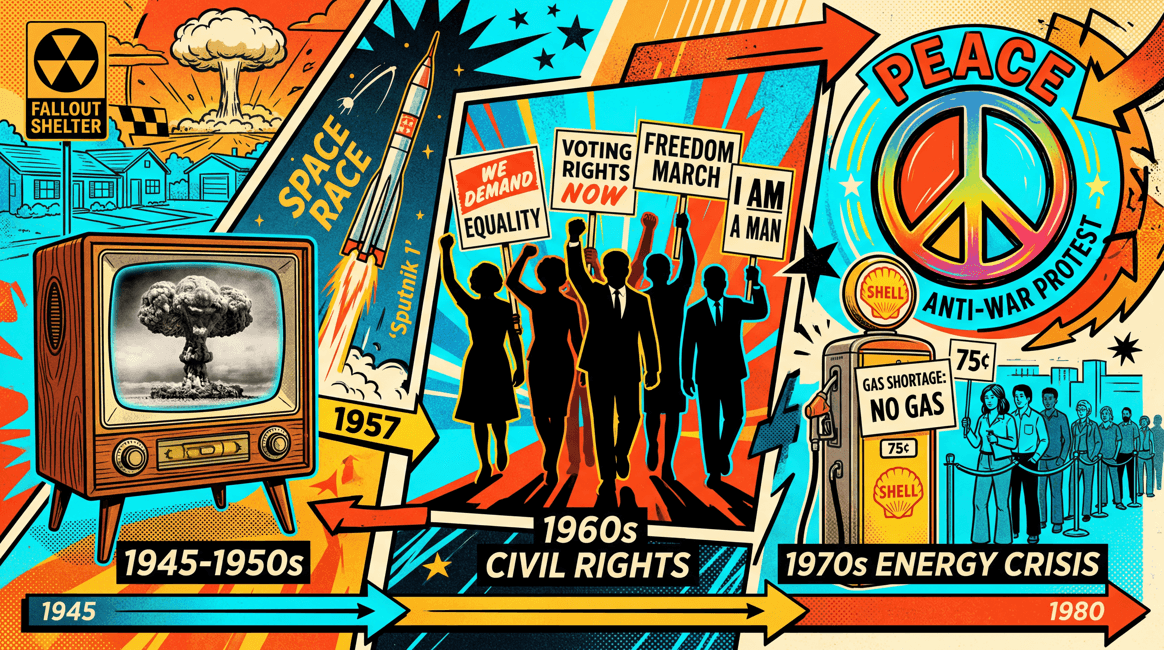
Welcome to the most chaotic, culturally defining, and politically explosive era in modern American history! APUSH Unit 8 (1945-1980) is a massive chunk of the exam, covering everything from the icy tensions of the Cold War to the passionate protests of the Civil Rights Movement. In this guide, we break down the exact timeline you need to memorize to score that coveted 5. We will explore:

  • The rise of global superpowers and nuclear anxiety
  • The fight for equality and transformative social movements
  • The shift from 1960s liberalism to the 1970s conservative resurgence Get ready to time-travel through the decades that built the modern United States!

Frequently Asked Questions

APUSH Unit 8 covers 1945 to 1980, starting with the end of World War II and the early Cold War and ending with the conservative resurgence and the election of Ronald Reagan. The period includes the Cold War, Civil Rights Movement, Great Society, Vietnam War, and 1970s crises like Watergate and stagflation.

Containment was the core US Cold War strategy, coined by diplomat George Kennan, of preventing the spread of communism rather than attacking the Soviet Union directly. It shaped the Truman Doctrine, Marshall Plan, NATO, and later interventions in Korea and Vietnam, and is one of the most common APUSH SAQ and DBQ topics.

Containment was the core US Cold War strategy, coined by diplomat George Kennan, of preventing the spread of communism rather than attacking the Soviet Union directly. It shaped the Truman Doctrine, Marshall Plan, NATO, and later interventions in Korea and Vietnam, and is one of the most common APUSH SAQ and DBQ topics.

Key milestones include Brown v. Board of Education (1954) overturning segregation, the Montgomery Bus Boycott (1955-1956), the Little Rock Nine (1957), sit-ins and Freedom Rides, the 1963 March on Washington, the Civil Rights Act (1964), and the Voting Rights Act (1965). Together they dismantled Jim Crow through courts, legislation, and direct action.

Key milestones include Brown v. Board of Education (1954) overturning segregation, the Montgomery Bus Boycott (1955-1956), the Little Rock Nine (1957), sit-ins and Freedom Rides, the 1963 March on Washington, the Civil Rights Act (1964), and the Voting Rights Act (1965). Together they dismantled Jim Crow through courts, legislation, and direct action.

The Great Society was President Lyndon B. Johnson's ambitious domestic program of the mid-1960s, aimed at ending poverty and racial injustice. It produced Medicare, Medicaid, Head Start, the Civil Rights Act (1964), and the Voting Rights Act (1965), expanding the federal role in ways that echoed and extended the New Deal.

The Great Society was President Lyndon B. Johnson's ambitious domestic program of the mid-1960s, aimed at ending poverty and racial injustice. It produced Medicare, Medicaid, Head Start, the Civil Rights Act (1964), and the Voting Rights Act (1965), expanding the federal role in ways that echoed and extended the New Deal.

The US escalated involvement in Vietnam because of the Domino Theory — the belief that if one Southeast Asian country fell to communism, others would follow. After the Gulf of Tonkin Resolution (1964), Johnson committed ground troops, and the Tet Offensive (1968) shifted public opinion, leading Nixon toward Vietnamisation and eventual withdrawal by 1973.

The US escalated involvement in Vietnam because of the Domino Theory — the belief that if one Southeast Asian country fell to communism, others would follow. After the Gulf of Tonkin Resolution (1964), Johnson committed ground troops, and the Tet Offensive (1968) shifted public opinion, leading Nixon toward Vietnamisation and eventual withdrawal by 1973.

Stagflation was the simultaneous stagnant growth, high unemployment, and high inflation of the 1970s, breaking the traditional tradeoff between inflation and unemployment. Causes included the 1973 OPEC oil embargo, heavy Vietnam-era spending, and collapse of the Bretton Woods system. It discredited Keynesian policy and helped fuel the conservative backlash.

Stagflation was the simultaneous stagnant growth, high unemployment, and high inflation of the 1970s, breaking the traditional tradeoff between inflation and unemployment. Causes included the 1973 OPEC oil embargo, heavy Vietnam-era spending, and collapse of the Bretton Woods system. It discredited Keynesian policy and helped fuel the conservative backlash.

The Watergate scandal (1972-1974) exposed illegal wiretapping and cover-ups by the Nixon administration, forcing Nixon's resignation in 1974. It deepened public distrust of government, led to reforms like the War Powers Act and campaign finance laws, and reinforced the 1970s mood that enabled the Reagan conservative revolution.

The Watergate scandal (1972-1974) exposed illegal wiretapping and cover-ups by the Nixon administration, forcing Nixon's resignation in 1974. It deepened public distrust of government, led to reforms like the War Powers Act and campaign finance laws, and reinforced the 1970s mood that enabled the Reagan conservative revolution.

The late-1970s conservative rise was fuelled by stagflation, Watergate-era distrust, the Iran Hostage Crisis (1979-1981), opposition to busing and affirmative action, and the growth of the Religious Right. These forces converged in Ronald Reagan's 1980 landslide, closing Unit 8 and opening the Reagan era of Unit 9.

The late-1970s conservative rise was fuelled by stagflation, Watergate-era distrust, the Iran Hostage Crisis (1979-1981), opposition to busing and affirmative action, and the growth of the Religious Right. These forces converged in Ronald Reagan's 1980 landslide, closing Unit 8 and opening the Reagan era of Unit 9.