professor-curious-logo

Mastering English B Text Types

Curated by dima

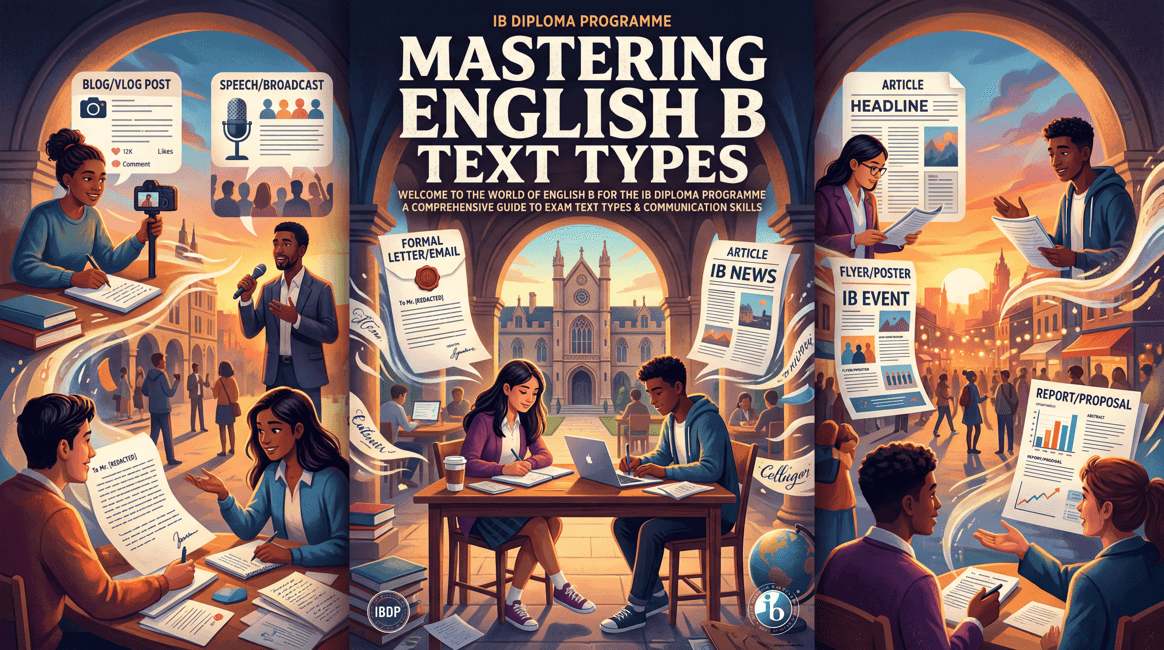
Welcome to the world of English B for the IB Diploma Programme! In this blog, we will explore the various text types you need to master for your exams. Understanding these text types is crucial not only for scoring well but also for enhancing your communication skills in real-life scenarios. From formal letters to blog posts, each text type has its unique structure and purpose. Let's dive into the fascinating realm of English B text types and discover how they can be applied in everyday situations.

Frequently Asked Questions

IB English B Paper 2 asks you to respond in one of several text types — most commonly formal and informal letters, emails, essays, articles, blog posts, and reviews. You choose a prompt and must follow that text type's conventions for structure, tone, purpose, and audience.

Formal letters use a professional register, structured paragraphs, conventions like "Dear Sir/Madam" and "Yours sincerely", and keep personal opinion restrained. Informal letters are conversational, use first names, contractions, and warm sign-offs like "Take care". The prompt tells you which register is required on exam day.

Formal letters use a professional register, structured paragraphs, conventions like "Dear Sir/Madam" and "Yours sincerely", and keep personal opinion restrained. Informal letters are conversational, use first names, contractions, and warm sign-offs like "Take care". The prompt tells you which register is required on exam day.

Start with a clear subject line that states your purpose. Use a formal salutation like "Dear Ms. [Name]", then briefly introduce yourself and the reason you're writing. Keep body paragraphs short and organized. Close with "Yours sincerely" and your full name. Maintain a polite, purposeful tone throughout.

Start with a clear subject line that states your purpose. Use a formal salutation like "Dear Ms. [Name]", then briefly introduce yourself and the reason you're writing. Keep body paragraphs short and organized. Close with "Yours sincerely" and your full name. Maintain a polite, purposeful tone throughout.

An essay argues a position with a structured intro, body paragraphs backed by evidence, and a conclusion — it feels academic. An article informs or entertains a wider audience, usually starts with a catchy headline and engaging lead, and uses a more flexible, journalistic structure with subheadings and short paragraphs.

An essay argues a position with a structured intro, body paragraphs backed by evidence, and a conclusion — it feels academic. An article informs or entertains a wider audience, usually starts with a catchy headline and engaging lead, and uses a more flexible, journalistic structure with subheadings and short paragraphs.

Open with an engaging hook and a clear personal voice — address the reader directly with "you". Organize around one main experience or opinion, using short paragraphs, anecdotes, and a conversational tone. End with a reflection, question, or call to action that invites the reader to engage. Personality and authenticity matter.

Open with an engaging hook and a clear personal voice — address the reader directly with "you". Organize around one main experience or opinion, using short paragraphs, anecdotes, and a conversational tone. End with a reflection, question, or call to action that invites the reader to engage. Personality and authenticity matter.

Open by naming what you're reviewing and giving a one-line summary. Analyze specific features — plot, characters, design, service, or cinematography — with concrete detail. Use evaluative language and balance opinion with evidence. Close with a clear overall verdict and recommendation, optionally a rating. Reviews reward specificity over generic praise.

Open by naming what you're reviewing and giving a one-line summary. Analyze specific features — plot, characters, design, service, or cinematography — with concrete detail. Use evaluative language and balance opinion with evidence. Close with a clear overall verdict and recommendation, optionally a rating. Reviews reward specificity over generic praise.

There isn't a universally easiest text type — it depends on your strengths. Informal letters and blog posts often feel most natural because they allow personal voice. Essays reward students who build structured arguments. Practice every text type in advance so you can pick whichever best fits the exam-day prompt.

There isn't a universally easiest text type — it depends on your strengths. Informal letters and blog posts often feel most natural because they allow personal voice. Essays reward students who build structured arguments. Practice every text type in advance so you can pick whichever best fits the exam-day prompt.

Match the register to the text type. Formal letters, essays, and articles require a formal register — no contractions, precise vocabulary, objective tone. Informal letters, personal emails, and blog posts use a conversational register with contractions and direct address. Reviews sit in between — analytical but accessible to general readers.

Match the register to the text type. Formal letters, essays, and articles require a formal register — no contractions, precise vocabulary, objective tone. Informal letters, personal emails, and blog posts use a conversational register with contractions and direct address. Reviews sit in between — analytical but accessible to general readers.