professor-curious-logo

AP Comparative Gov Unit 2 Cheat Sheet

Curated by Claudia

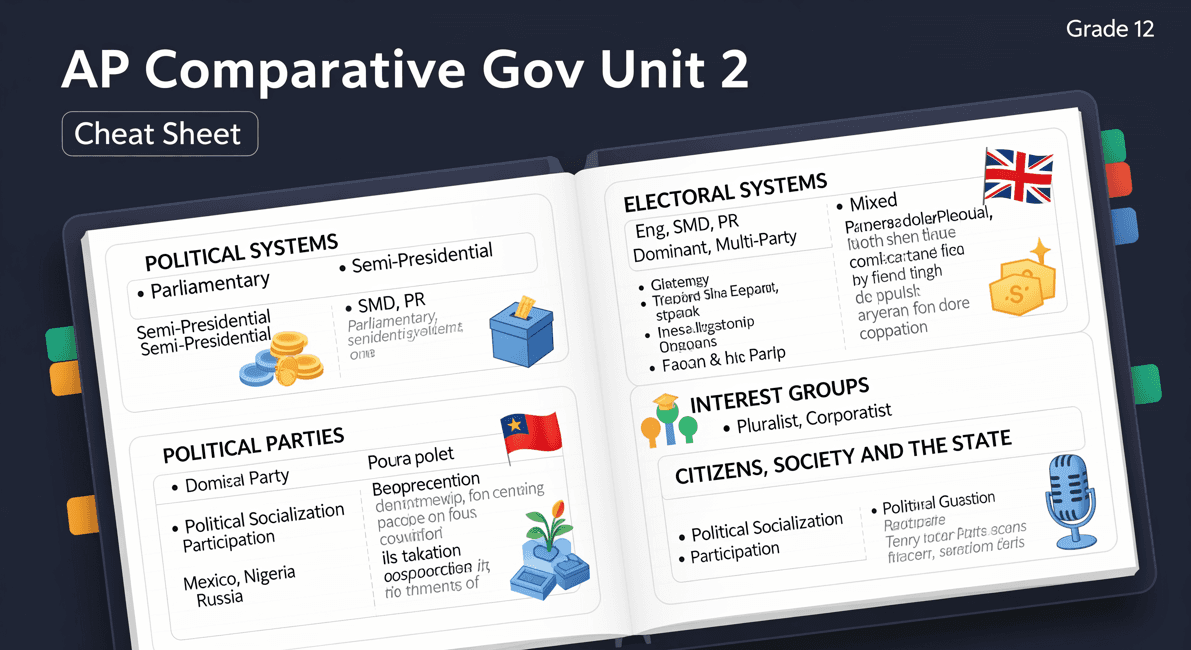
Tackle AP Comparative Government Unit 2 with a compact, high-impact study guide made for Grade 12 students. This guide turns dense concepts into clear comparisons, memorable examples, and focused exam practice — perfect for last-minute review or steady study.

  • What this guide covers: key roles of executives, legislatures, judiciaries, bureaucracies, electoral systems, and political parties; how institutions shape policy and power.
  • Real-world examples: brief links to the UK’s parliamentary system, China’s party-state structure, Russia’s presidential power, Mexico’s federal legislature, Iran’s theocratic institutions, and Nigeria’s political fragmentation — ready to cite in SAQs and FRQs.
  • Study tools included: quick comparison tables, a 1-page institution checklist, common FRQ prompts, and exam strategies (how to compare, use evidence, and structure answers).

Use this guide to build clear comparisons, sketch quick diagrams, and practice concise writing — the skills the AP exam rewards.

Frequently Asked Questions

AP Comparative Government Unit 2 covers political institutions — executives, legislatures, judiciaries, bureaucracies, electoral systems, and political parties — across the six course countries (UK, China, Russia, Iran, Mexico, Nigeria). You compare how each institution is selected, how it shares or checks power, and how institutional design shapes policy outcomes.

In a parliamentary system (UK) the executive is chosen by and from the legislature, fusing the two branches. In a presidential system (Mexico, Russia in practice) the executive is elected separately, creating separation of powers. Parliamentary systems allow votes of no confidence; presidential systems have fixed terms.

In a parliamentary system (UK) the executive is chosen by and from the legislature, fusing the two branches. In a presidential system (Mexico, Russia in practice) the executive is elected separately, creating separation of powers. Parliamentary systems allow votes of no confidence; presidential systems have fixed terms.

The UK fuses executive and legislature: the Prime Minister leads the majority party in the House of Commons, the cabinet comes from Parliament, and Parliament is sovereign. The independent Supreme Court conducts judicial review, and elections use first-past-the-post, which favours two large parties like Labour and Conservatives.

The UK fuses executive and legislature: the Prime Minister leads the majority party in the House of Commons, the cabinet comes from Parliament, and Parliament is sovereign. The independent Supreme Court conducts judicial review, and elections use first-past-the-post, which favours two large parties like Labour and Conservatives.

Duverger's Law states that single-member, plurality electoral systems like the UK's FPTP tend to produce two-party systems, while proportional representation encourages multiparty competition and coalition governments. It helps you explain why party systems differ between the UK and countries with PR, and is a common SAQ/FRQ hook.

Duverger's Law states that single-member, plurality electoral systems like the UK's FPTP tend to produce two-party systems, while proportional representation encourages multiparty competition and coalition governments. It helps you explain why party systems differ between the UK and countries with PR, and is a common SAQ/FRQ hook.

China is a single-party state where the Chinese Communist Party directs the government through parallel party structures. The National People's Congress formally passes laws but defers to the Politburo Standing Committee. Courts are not independent, and the CCP controls recruitment through the nomenklatura system, making accountability upward rather than to voters.

China is a single-party state where the Chinese Communist Party directs the government through parallel party structures. The National People's Congress formally passes laws but defers to the Politburo Standing Committee. Courts are not independent, and the CCP controls recruitment through the nomenklatura system, making accountability upward rather than to voters.

Iran has a two-track structure: elected institutions like the President and Majles sit below unelected clerical bodies. The Supreme Leader and the Guardian Council vet candidates and can veto legislation, so policy direction ultimately rests with religious authorities rather than electoral outcomes.

Iran has a two-track structure: elected institutions like the President and Majles sit below unelected clerical bodies. The Supreme Leader and the Guardian Council vet candidates and can veto legislation, so policy direction ultimately rests with religious authorities rather than electoral outcomes.

Use the UK Supreme Court (created 2009) as a strong example of independence and judicial review, contrast with Russia where courts are politically constrained, and cite Iran's Guardian Council as a body that blurs judicial and political power. Strong FRQ answers define the concept, give an example, and explain the institutional reason.

Use the UK Supreme Court (created 2009) as a strong example of independence and judicial review, contrast with Russia where courts are politically constrained, and cite Iran's Guardian Council as a body that blurs judicial and political power. Strong FRQ answers define the concept, give an example, and explain the institutional reason.

Start with a clear thesis that names the concept and the two countries, then explain the concept in one sentence, give one specific piece of country-specific evidence for each side, and finish with an analytical comparison of why they differ. Avoid listing facts — the AP exam rewards direct comparison and institutional reasoning.

Start with a clear thesis that names the concept and the two countries, then explain the concept in one sentence, give one specific piece of country-specific evidence for each side, and finish with an analytical comparison of why they differ. Avoid listing facts — the AP exam rewards direct comparison and institutional reasoning.